

Introduction — Manufacturing Reveals, It Rarely Creates
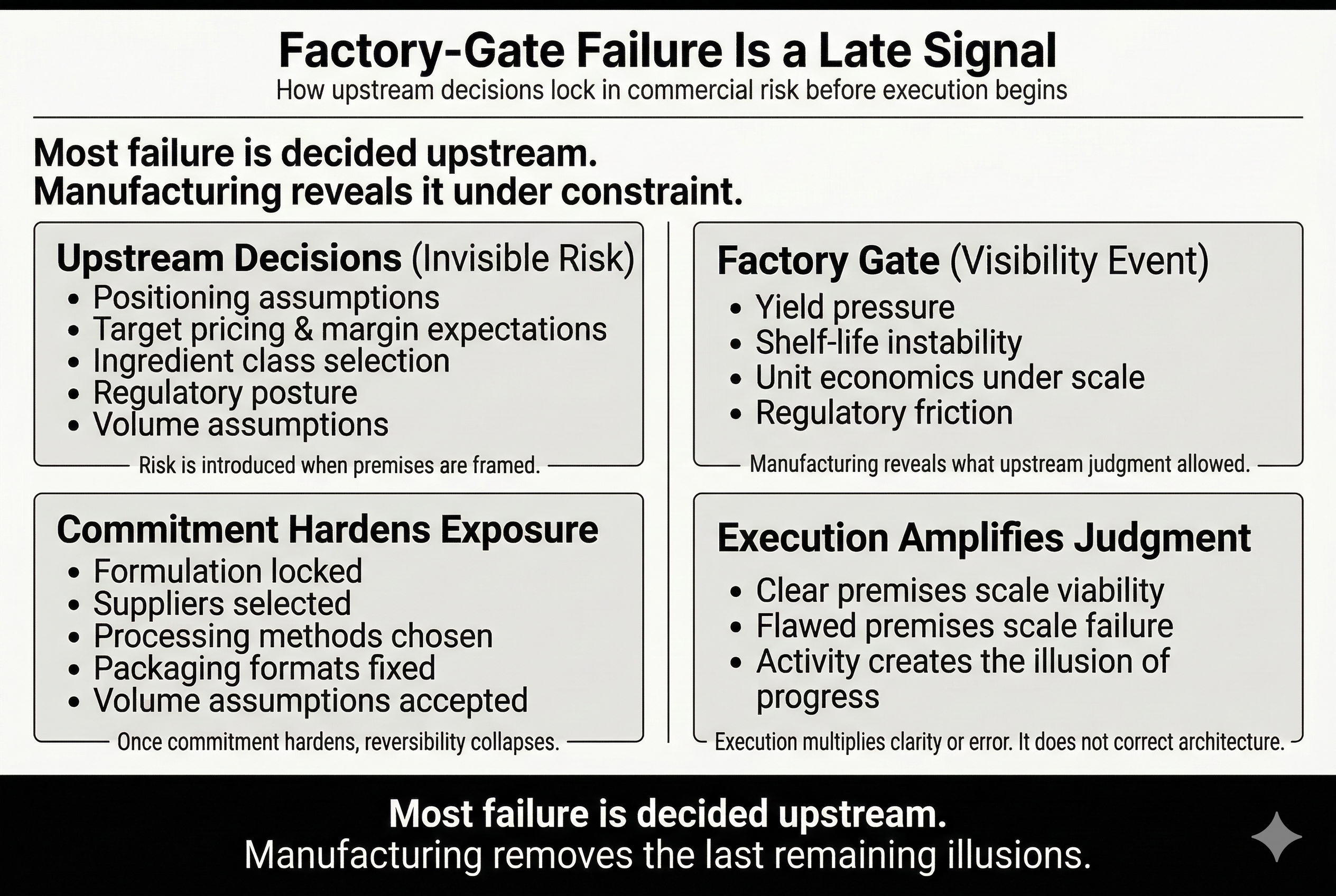
Manufacturing is where commercial reality becomes unavoidable. It is not where most food and beverage product failure originates. The factory gate is the first point at which assumptions encounter constraint at scale.
When products fail at this stage, failure is commonly attributed to technical execution: supplier quality, process instability, yield loss, or regulatory friction. These explanations point to the first visible bottleneck. They are rarely causal drivers of failure. Across categories and markets, the same structural pattern repeats: commercial risk is introduced long before manufacturing begins. Decisions about positioning, formulation direction, cost targets, regulatory posture, and volume assumptions quietly define what manufacturing will be allowed to succeed at later.
By the time production is engaged, reversibility has already begun to collapse. Manufacturing does not create most failure; it reveals earlier misjudgment under conditions that can no longer be ignored. Treating factory-gate failure as a manufacturing problem shifts accountability to the most visible point in the system, while preserving the upstream architecture that produced the failure modes in the first place.
Failure is not an event. It is a consequence of how judgment was governed earlier.
Factory-Gate Failure as a Visibility Event
The factory gate functions as a visibility event. It is the first environment where upstream premises encounter binding constraints under volume. Yield pressure, shelf-life instability, unit economics under scale, and regulatory friction surface at this point because they were always latent in the system. They were encoded when early decisions were framed.
Organizations exhibit a structural bias toward visible causes. Early judgment is invisible. Assumptions about cost tolerance or formulation feasibility do not produce immediate friction. Manufacturing does. As a result, manufacturing absorbs blame for failures that were structurally created upstream. The typical response is downstream repair. Each iteration becomes more operationally complex and strategically fragile, while the architecture that produced the failure remains intact.
Where Risk Is Introduced
Most commercial risk is introduced when premises are framed. Early-stage flexibility creates a dangerous tolerance for incomplete judgment. Small-batch success is mistaken for feasibility. Cost volatility is deferred. Shelf-life constraints are framed as technical issues to be solved later. Regulatory friction is assumed to be navigable.
These early premises typically harden into constraints across five areas:
- Positioning assumptions — Market promises that dictate product design and limit future pivots.
- Target pricing and margin expectations — Financial ceilings that restrict feasible manufacturing methods and ingredient quality.
- Ingredient class selection — Formulation choices that limit processing options at scale.
- Regulatory posture — Early compliance assumptions that constrain permissible choices later.
- Implicit beliefs about manufacturability — Treating shelf-life or scale limits as problems to be solved downstream.
As projects progress, these constraints lock in. By the time they surface on the factory floor, the organization is committed to a direction that was never governed under real commercial conditions.
Execution Amplifies Judgment (A Concrete Illustration)
Execution multiplies the quality of prior judgment. When premises are aligned with constraint, execution scales viability. When premises are misaligned, execution scales failure.
A common scenario in food and beverage illustrates this dynamic. An upstream marketing team prioritizes an “ultra-clean label,” selecting a novel, minimally processed plant-based binder. Informal sensory validation performs well in the test kitchen. At scale, natural moisture variability in the raw ingredient introduces instability during thermal processing, driving significant yield loss. Operations is blamed for “process instability,” and resources are deployed to optimize the line.
The failure did not originate in operations. It was locked in when the ingredient class was selected without governing its manufacturability under real variance at scale. Operational competence can temporarily mask misalignment. It cannot correct flawed architecture.
The Illusion of Downstream Fixes
Downstream fixes are rational responses to visible exposure. Shelf-life extension, formulation adjustment, packaging modification, and MOQ renegotiation are treated as rescue mechanisms. These actions manage symptoms. They rarely correct upstream misjudgment.
In practice, downstream fixes convert structural error into operational complexity:
- Costs rise.
- Supply chains become more fragile.
- Dependencies increase.
- Strategic optionality diminishes.
Over time, products become harder to manage and less resilient to volatility. Failure becomes embedded rather than obvious.
Related Insight:
Reversibility Collapse and the Cost of Late Learning
Learning is cheapest when reversibility is high. Early misjudgment can be corrected quietly without capital exposure or reputational damage. As commitment hardens, reversibility collapses. Mistakes that could have been fixed upstream now require public correction downstream. Capital is deployed, channels are engaged, and supply chains are activated.
This shift alters organizational incentives. Teams defend direction because changing course implies acknowledging sunk costs. Organizations continue investing in structurally misaligned products long after misalignment becomes visible—not because they lack discipline, but because commitment reshapes what is politically and financially tolerable to reverse.
Decision Implications: Moving Governance Upstream
Treating factory-gate failure as a manufacturing problem ensures the upstream decision architecture remains intact, reproducing the same failure modes across subsequent launches. The durable intervention point exists before commitment hardens. Governing judgment upstream requires structural changes to how products are greenlit:
- Relocate viability checks upstream. Operational viability should be governed at the concept and architecture stage, not deferred to scaling. Constraint mapping must occur alongside formulation.
- Define the “point of no return.” Explicitly map where reversibility meaningfully collapses (e.g., bespoke ingredient contracts, dedicated tooling). Require a hard commercial-reality audit at this gate.
- Differentiate sensory validation from scale validation. Small-batch success is not a proxy for factory readiness. Treat these as distinct validations governed by different constraints.
Factory-gate failure is a late signal. It reveals what early judgment already decided. By shifting accountability and governance upstream, organizations move from managing exposure to designing for reality.