

Insight Hub
Role & Responsibility
Loading…
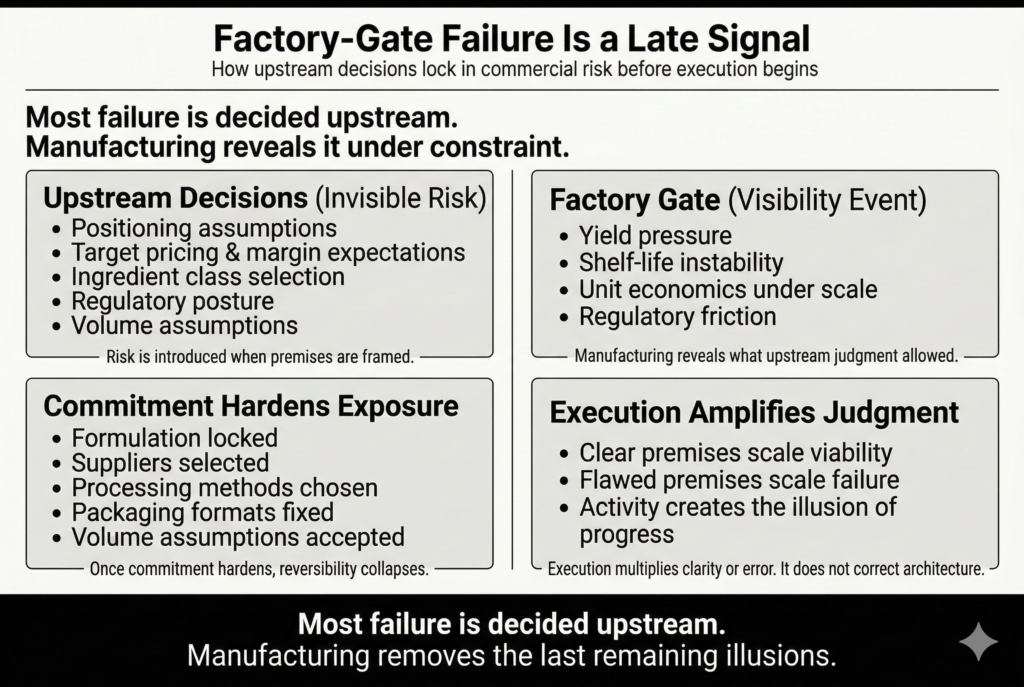
Why most food & beverage product failures are decided upstream and only revealed at manufacturing. A decision-risk analysis for founders, operators, and investors who carry consequence.

Why external execution functions as enterprise risk control in large ANZ CPG organisations — containing volatility, preserving internal systems, and protecting ROI during early-stage innovation.

In Australia–New Zealand, capable beverage teams misjudge manufacturing, novel ingredients, compliance, and shelf-life constraints when internalising validation. This Insight examines why intelligence does not prevent scale-stage failure.

Expanding farms compounds price-taker risk. A single, well-judged downstream SKU allows risk to
be staged, judgment to precede irreversibility, and capital to compound instead of being locked into
low-control economics.

Value is not created at harvest. It is captured through downstream control of product format,
compliance positioning, and shelf access. Farm gate economics structurally cap producer outcomes
in ANZ markets.

Moving from distributor to brand owner does not automatically fix margin leakage. In ANZ, ownership only changes outcomes when upstream control, cost architecture, and manufacturing optionality change with it.

Owning distribution does not guarantee margin control. In ANZ, operators lose leverage when upstream IP, pricing logic, and manufacturing optionality remain outside their control.

Why category expansion fails inside large ANZ CPG organisations — and how testing new categories without binding core systems too early protects brand, capital, and internal credibility.

White-label speed shifts distributors into a pricing tier between wholesale and true manufacturing economics. In ANZ, this middle pricing erodes margin while preserving OEM control over formulation and leverage.

Why speed in smaller teams comes from constrained risk and judgment discipline — and how large CPG organisations in Australia and New Zealand can replicate velocity without exposing core brands or internal systems.

Raw agricultural output does not scale wealth. Without downstream products and brand positioning,
farm assets remain structurally locked into price-taker economics in ANZ markets.

In Australia–New Zealand, delaying beverage validation until manufacturing exposes founders to irreversible cost, compliance, MOQ, and reputational risk. This Insight explains where losses enter and why late validation structurally increases failure.